Saturday, July 16, 2011

Tommy Thompson


I had a very enjoyable day as Jo'burg 60's conductor yesterday. The Museum was quiet so there was time to talk to visitors. One young man told his teacher that Crich is better than Alton Towers. I had to concede to a French guy that they were better at building new tramways than we are and I met a man from Manchester who remembered going to school on Salford trams but had never seen Manchester 765 in Heaton Park. He promised to go one weekend soon. Finally here is a picture to sum up my day. Ken Morgan and his wife who had finally come to see the Museum that he had heard so much about from his friend Tommy Thompson. (For younger readers Tommy used to travel up regularly from London and is a former President).
The other tram in service was Glasgow 22 and Berlin 3006 made one trip.

I have now found a picture of Tommy during his 1994/5 presidency. I don't remember the reason for the champagne but I recognise Matthew Paris, Tommy Thompson and Geoffrey Claydon.

Money wasted (2)

A reply from a TMS member together with my comments in blue.

"You seem to show a habit which is all too prevalent these days, the negation of the concept of human error. People make mistakes or to be more precise make decisions which with the benefit of hindsight are identified as mistakes but quite frequently appear to be the correct decisions at the time and under the circumstances then.
I agree about human error. All I want is for mistakes to be admitted. "Sorry chaps we got this wrong".
Tramcars with PCC technology operate successfully in museums with their own lines in the Netherlands, in Denmark, in Sweden and in Germany*. Why the museum which is probably the leading tramway museum in the world should be unable to follow is beyond my comprehension. The only explanation I can offer is a reluctance to accept foreign technology. One issue which has been overlooked without doubt is the door height which is too low for a standing person pushing a wheelchair. This will require some extra modifications to the door, which have been carried out elsewhere.
We have operated a PCC type tram at Crich - Leeds 602 but with restricted use and restricted drivers. A very, very important requirement for an Access Tram at Crich is for all drivers to be able drive it. I have driven most trams at Crich but never 602.
As far as Town End is concerned, the answer is in the issue of "The Journal" you mentioned: "A 'minimum cost' job was required."
When judging 345 please consider two issues: The experience of the persons working on the car and responsible at Board level on one side and the legacy presented by Leeds Corporation on the other side. With hindsight we have human error on all sides again, I think.
These are factors that should have been considered by the Board before allocating resources to the project.
I cannot comment on 159, but could you please elaborate on "nearly every job has had to be re-done"?
OK. A significant number of jobs have had to be redone. Examples that come to mind are body side panels, dash panels and the bogie frames pictured on the rear cover of Journal 194 were discarded.
And finally, I question the responsibility of the three Board members seeking re-election. Only two out of four were Board members then 902, Town End and 345 happened. Only three were Board members when the restoration of 159 started. Only one was Board member responsible when the most of the work you criticise was carried out but has not been responsible for 159. A case of "journalistic inexactitude" perhaps?
With regard to who was on the Board and when, all Board members are Trustees of the Tramway Museum Society and have legal responsibilities to conserve our Museum and its assets. In this they are all failing."

Friday, July 15, 2011

Elections

I have received this letter from a TMS member. It is a bit long but I have decided to publish it unedited as it makes some valid points.

"I read with delight the questions you would have liked to present to the 5 members who are seeking election to the `Board of Management'.
There is the start of another telling series of questions, ` Board of Management''?
My office must be in a mess as I cannot find the copy of the TMS Board of Management organisational chart, and details of the associated committees their membership, mandates and responsibilities.

Yes your idea of a hustings is very good and would offer an opportunity for members to, in an open forum, question each candidate. It would definitely remove the chaff, and confirm any allegiances, `party games'. Declared proposers and seconders do hint at parties and camps.
What I cannot get my head around is how a candidate is able to propose another candidate for election to the same board, see Karen Rigg. Or are there two members called R. A. Sykes. The implications for the future activities of the Board are are quite worrying!

To return the possibility of an open hustings:-
  • I would have asked about the future direction of the museum.
  • How would they improve the embedded procedures for responding to concerns, be they improper behavior, acts of intimidation, bullying or ineffective/ poor management. (the acid test of a good organisation is the way it handles and manages problems, external and internal).
  • Their intended behavior as a board member, team member, or an individual promoting own agendas.
  • How would they undertake the duties and responsibilities that go with the elected position of a board member; the associated perceived expectation of professionalism by the membership.
  • How would they improve the volunteer experience and how would they embrace and motivate the volunteers with the specific experience, skills and competences, of value to the museum. The volunteers who some in the museum perceive as a threat to their hierarchical positions and status.
Just a few more thoughts to fuel the attempts to create a more team orientated friendly caring museum family."

I too am disappointed at the tone of some of the comments and I think we should leave references to WW II to the 1940s events. The only way to solve this problem is create genuine opportunities for members to express their opinions and to receive considered replies. Simply saying "No Vacancies",  "Go Away" is no longer acceptable and leads to anger, frustration and back-stabbing. 
The forums recommended by Wim and Christoph are one way streets. Members put forward ideas but they are treated with contempt by those on high who never respond. 
Richard Lomas

    Poor old 1297


    I thought the idea of the exhibition hall was to display the trams as they would have been seen in the streets over the decades. OK so moaning about loudspeakers on the roof is a bit nit picking (joe public wouldn't notice) but I can't recall ever seeing a Glasgow tram displaying flat screen videos. I don't think they had been invented in 1962.
    Please, please, please don't deface 264 and have a little more respect for all the trams you are supposedly conserving. 

    Thursday, July 14, 2011

    A Trading Loss

    A long-standing TMS member who is also an accountant has sent me this report. He has also written privately to the Chairman.


    "My message is simple: The Annual Report shows an operating loss of £121,000. Neither the Chairman nor the Treasurer give any explanation about why and how the loss has arisen or what the Board intend to do to return the TMS to profit for 2011/12 and beyond. In the report many paragraphs are devoted to other matters but no indication given as to what steps are or will be taken to reduce operating costs and maximise income in the current financial year to turn the fortunes of the TMS around.
    In the circumstances, it is not wrong for a request to be made to the Boad to publish its operating budget for 2011/12 and actual figures for the first quarter to demonstrate the effectiveness of action taken to return to profitable operation."

    Stone workshop (16)

    The stone workshop looks magnificent now that the contractors have left.

    The main entrance.

    The alternative entrance is by a glass bridge to the workshop viewing gallery.

    The bridge from the workshop side.
    I will publish a few more pictures of the displays in the next few days. The trams in service yesterday were Chesterfield 7, Glasgow 22 and Southampton 45 and Berlin 3006.

    Wednesday, July 13, 2011

    Money wasted

    Halle 902
    In February 2005 when I retired from full time work, I rejoined the TMS after an absence of about 10 years. On a winter's afternoon I attended for a medical and couldn't believe my eyes. A big red Tatra T4D at Crich! Unbelievable. When I learnt that it was to be a second Access Tram, I knew something was badly wrong in the decision making process.
    I have known Tatra T3s and T4s since my first visit to Prague in 1966 and ridden thousands of kms on them over the years. I love these Tatras and was thrilled to ride on a few last week in Bucharest. However it would be difficult to think of a more unsuitable access tram. Tatras are very power hungry with fast acceleration and jerky braking at low speeds even when driven by experienced drivers. The foot pedal operated control system is different from any other tram at Crich and requires different driving techniques.

    Town End track
    The track at Town End was relaid by contractors early in 2005 but the old rails were re-used. Five years later the job was re-done using new materials. (For details of these abortive projects see Journal 190, April 2005).

    Leeds 345 and LUT 159
    On April 1st 2006, Leeds 345 was officially launched after a complete restoration funded by the TSO. Now 5 years later a small fortune is being spent by the TMS trying to put it right. There has recently been a call, which I support, to stop spending good money after bad and make 345 a static exhibit.
    The restoration of 159 funded by the LCCTT is nearing completion and this magnificent tram may well run next year but nearly every job has had to be re-done at the expense of the TMS.

    All these debacles divert resources from other projects and yet no apologies or explanations are given and no one is held to account. I will try to find out how much money has been wasted at the AGM - it will be thousands, perhaps a million pounds. I find it incredible that 3 of the Board members responsible for these disasters are seeking re-election. They won't get my votes.

    Tuesday, July 12, 2011

    Metrolink update

    Frank Bagshaw writes: "Richard - I'm sure you are aware that the first part of the South Manchester line opened last week. I've been over there today and am attaching a couple of photos. I'm also sending you one of the new stop at Abraham Moss on the Bury line that opened a few weeks ago."


    Posted by Picasa

    Questions for Candidates

    Perhaps in the future a day will be set aside when Members can meet candidates for election to the Board and ask them for their views and ideas before deciding how to cast their votes. All we have at the moment are very short statements that have been so thoroughly vetted by by the Thought Police as to be meaningless.
    I have read these statements and thought what would my first question be if I was able to speak to the candidate.

    Andrew Pendleton.
    Hello Andrew you say that the Museum "needs candidates with the energy and vigour to tackle difficult issues head-on". Would you like to mention a couple of today's difficult issues and how you would like to see them resolved?

    Karen Rigg
    Hello Karen you say that "it is essential for paid employees and volunteers to work together". Would you give an unequivocal guarantee that in any future disciplinary situation, volunteers will be accorded the same rights as employees enjoy by statute?

    Nick Sturgess
    Hello Nick. I believe that in an other forum you have advocated the appointment of a Museum Director as a matter of great urgency. Is this still the case?

    Richard Sykes
    Hello Richard you say that "I would continue to work for Members' interests". I think that the Museum is skewed in favour of employees at present. Could you give a couple of examples of how you would advance Members' interests?

    Malcolm Wright
    Hello Malcolm you boast that "I have increased my support to the Museum to around 150 days a year". Yes but what are you actually going to do in the future?

    Finally If any of the candidates want to use this blog to canvass their ideas I will be happy to publish them. Unedited!

    Monday, July 11, 2011

    Annual Report

    Whilst we were on holiday the Annual Report was published and I read some confusing and contradictory views about the Society's finances. Unlike many organisations these days the TMS has never been saddled with a debt mountain and all the Treasurers over the years are to be congratulated on that.
    However the graph on page 15 shows that although the Society may have some money in the bank it is actually trading at a loss and the defecit is being made up by windfalls such donations and bequests.
    My major concern is that whilst income from admissions, retail and catering is falling, the wage bill is rising from 59% of this income in 2010 to 63% in 2011 and from my limited observations as a volunter tram conductor, will rise again next year.

    Sunday, July 10, 2011

    Curatorial Inexactitudes

    One of the pleasant surprises about Moldova and Romania is that free internet access is common in hotels, so I have been reading the Yahoo news group posts about the NTM in unlikely places. The term "Curatorial Inexactitudes" cropped up several times so I asked Google what it means and this is what I found in the context of a military tank museum.

    Museums don't make mistakes - I have it on good authority that they are "Curatorial Inexactitudes"

    Regarding not altering the notice - nothing in a museum happens quickly. After all, they get paid whatever, the stuff has been sitting around rusting for 60 years so another decade makes no difference and if they have a desk piled high with paperwork they will look busy so nobody bothers them. I know, I worked in a museum for 8 years.
    I have a very low opinion of curators - I've seen them in "action"

    However the NTM is fortunate in that one of the candidates seeking re-election to the Board claims to be concerned about Curatorial Inexactitudes. I was gobsmacked because my simple request for Sheffield 264's trolley rope to be removed was rejected out of hand about a year ago. A later request for loudspeakers and their associated cables to be removed was also rejected.


    I accept that some compromises are required to operate historic vehicles and provided that these are documented I personally see no harm in this. However when a tram is placed in the exhibition hall as a permanent static exhibit then I think that detailed histrical accuracy is very important. The most glaring example I can think of is Howth 10 which had major modifications to enable it run in Blackpool and these have not been corrected.
    It might help future Curatorial Exactitude if a formal survey of the entire fleet was carried out whilst there are still old codgers around who remember the trams in service. Are any of the candidates for Board membership up for organising this? I would gladly do the clerical work from home.
    In the meantime why not add a comment about the Curatorial Inexactitude that you find most most irritating.

    Moldova, Transnistria and Romania

    We have now returned home and in the next few days I will write a summary of our trip to Moldova, Transnistria and Romania.


    We have now returned from a two-week trip around Moldova, Romania and Transnistria, a country that doesn’t exist, using public transport. Whilst back packers often travel on buses and trains, what on earth were an English grandfather and grandmother doing? The answer is filling in gaps in their travels around Europe and the former Soviet Union. We have visited most European countries but had never been to Moldova. Before 1940 when it became part of the USSR most of Moldova was in Romania. With the collapse of the Soviet Union in 1991 it became independent. However, in 1992 a small area to the east of Moldova next to the Ukrainian border broke away by force and declared itself independent. It is not recognised by any other country, has peace keeping forces from Russia and venerates the Soviet Union. This strip of ‘no man’s land’ leads to problems for travellers but just like the old East Berlin it can easily be visited with a day pass.
    We flew from Luton to Timisoara in northern Romania by Wizz and then onto Chisinau, the capital of Moldova, by Carpatair the same afternoon. Border formalities were quickly completed with the all important entry stamp and the word ‘welcome’. We returned from Bucharest (Banaesa) again by Wizz just two weeks later. All three flights left on time and arrived early and the only complaint was the chaotic check in for the return flight.  
    Moldova is said to be the poorest country in Europe and in recent years there has been very little investment in public transport or infrastructure. Chisinau, the capital, was badly damaged in WW II and was rebuilt to the standard Soviet pattern with very little other than the language to suggest a Romanian past. Now all Russian public notices and street signs have been replaced in a city where many of the people speak Russian. There is still a large trolleybus network with three depots and an intensive service on the main street where private minibus competition is restricted. Each depot seemed to have a few of the new trolleybuses on one of its routes. The trolleybus fare is about 12p and, as in many former Soviet cities; conductors are used to collect cash fares. The privately owned minibuses have slightly higher fares collected by the driver, cash in hand. The busiest trolleybus route has a 4 minute frequency but in the past it has been every 2 minutes. There are few full size diesel buses.
    For me the country buses were more interesting. Moldova has few railways and they are Russian gauge. There is an overnight train to Moscow and another to Bucharest (with bogie changing at the border) and two or three other trains so people rely on buses. There are three bus stations and tickets for the longer services can be pre-booked. We had to show our passports to buy tickets for a minibus to Iasi in Romania but were able to buy tickets to Tiraspol in Transnistria with no formalities. Many of the buses obviously serve rural communities and park up for several hours during the day. Destinations are displayed in a mixture of Romanian and Russian presumably indicating the dominant local language. Again most of them are minibuses.
    The day of our visit to Tiraspol we simply went to the bus station and bought two tickets for the next minibus departing at 08:40. On boarding the bus we were given two ‘control’ forms which were printed in Russian and English and asked for passport details, purpose of visit etc. There are no controls on the Moldovan side of the border but all passports were collected at the first Transnistrian checkpoint. After 10 minutes or so they were returned and the bus moved forwards to the second check point where non-locals had to get out and go into an office and join a queue. My passport was examined by a young lady who seemed happy to practice her English and explained that our day passes were only valid until 19:50. The control document was duly stamped and countersigned and returned with our passports. We then returned to the minibus and waited until everyone had been processed. The whole process took about an hour and we arrived at Tiraspol just after 11:00. No the exchange office didn’t accept Pounds so we changed 20 Euros into Transnistrian Roubles for spending money. Our first impression was that Tiraspol was poorer than Chisinau and that the trolleybuses were infrequent. We walked down the main street which must have changed very little in twenty years. In addition to the trolleybuses there were a few minibuses but there was far less traffic than in Moldova. We visited a local market and this confirmed our views on the economy. We had a nice lunch in Romanian owned Pizza chain and then coffee and ice cream during the afternoon and the spent the last of our Roubles on tickets for a bus back to Chisinau at about 17:00. The border controls for the return journey seemed less stringent and we didn’t have to leave the bus. Our passports and control forms were collected and then just our passports were returned. There were no stamps to indicate we had been to Transnistria and our Moldovan entry stamp was untouched. There was no hint of the bribes reported in many travellers’ tales.
    Two days later we took a minibus from Chisinau to Iasi in Romania. This involved two and a half hours on awful roads to the border. As this is a recognised border the Moldovans checked our passports carefully before stamping us out. Everyone then had to take their entire luggage to the customs hall and every bag was opened. The customs officer wasn’t expecting English grandparents and wanted to know about our travels and how we would get home. We didn’t mention Transnistria and were soon on our way with a friendly wave and wishes for a pleasant journey. The minibus crossed a river bridge and then we joined the queue for entry into the European Union. Our status had changed. The Romanians processed EU passport holders first and we only needed to identify our baggage and explain that some English grandparents actually like Romania. The road from the border to Iasi seemed remarkably smooth and we arrived at about 15:00. We were now in familiar territory as we had visited Iasi four years ago.
    We were surprised how little Iasi and its tramways had changed in four years and conversations later confirmed our view that this is now one of the poorest parts of Romania. There is still quite a lot of trolleybus overhead although the network had closed just before our previous visit. Romania has a reasonable rail network and a computerised booking system. Train times can be found on the DB and Romanian Railways websites and tickets including seat reservations can be booked several days in advance. So on arrival in one town we simply bought our tickets to the next. We had already booked hotels through the booking.com website.
    The steel making town of Galati was our next destination. First we noticed that trams no longer passed the station and then although there were tracks near our hotel there was no overhead. About half the Galati tramway has been abandoned in recent years and minibuses are endemic. Most of them are smart and modern and some are route branded. The trams are from Rotterdam and Berlin and in reasonable condition. There are three tram routes left and as a lot of the track is worn out I suspect they will close fairly soon. In Braila the situation is very different with a significant part of the tramway closed but this time for reconstruction in the town centre.  At present there is only one cross town route operated by trams from Vienna and Rotterdam with both track and trams in reasonable condition. Then there is an hourly suburban service to a deserted industrial complex which was surprisingly busy although we suspect that fare evasion was rife on this route. It was operated by an ex Berlin Tatra KT4D. There was an interesting selection of buses including Ikaruses, Dutch DAFs and some newish BMC midibuses.
    In all three of these towns tickets are sold from kiosks and cancelled in traditional ‘komposters’. Day tickets are also available although you have to produce photo id to buy one in Iasi. Single fares varied from 26p to 40p. In Bucharest things are very different with a difficult to understand smart card system and traffic inspectors who obviously revel in catching out and fining visitors on the airport express bus service. The ticket blanks cost 33p which is added the cost of the ticket.
    It is obvious that Bucharest has received far more public transport investment than the other three towns we visited. Those sections of the tramway that we saw were in acceptable or good condition and lots of stops have passenger refuges and platforms. The trams are old but in quite good condition so that all that is need now are some modern low floor cars. The city buses were nearly all air conditioned low floor Mercs. There are also some trolleybus routes with quite modern looking vehicles but we didn’t have the time or the energy to look at them as it was 36 degrees C and quite humid.
    I have published pictures of our trip on this blog and focustransport2011.blogspot.com between 25th June and 9th July.

    Saturday, July 09, 2011

    Buchuresti on Friday

    Most Bucuresti trams are artics like these. They were built in the 70s and 80s and have been heavily modernised. The route network has been rationalised with closures and overlapping services beimg reduced. Three trams at the terminus seems excessive until you realise that there is a 2 minute frequency on service 41.

    Some of the cars now have low floor centre sections.

    Most Bucuresti trams are single ended but there are a handful of double ended ones. These were on service 5 to Baneasa which had been cut back about 1 km because of road works and track renewal.


    Posted by Picasa

    Friday, July 08, 2011

    Tatra T4Rs

    These Tatra T4Rs were new to Bucuresti in 1973-75. They are well maintained but still have the original technology. For me these trams were one of the highlights of our trip.


    Posted by Picasa

    Thursday, July 07, 2011

    Remembering 1982


    Posted by PicasaToday we met Andreea Dogar a reporter from a new Romanian news web site who was interested to find out more about our visit to Romania in 1982 and also why anyone would be interested in trams. I will add a link when her article is published.

    Wednesday, July 06, 2011

    Braila

    There are about 4 Lei to the Euro. So the cost of this project including 4 km of new tram track is about 31 million Euros.

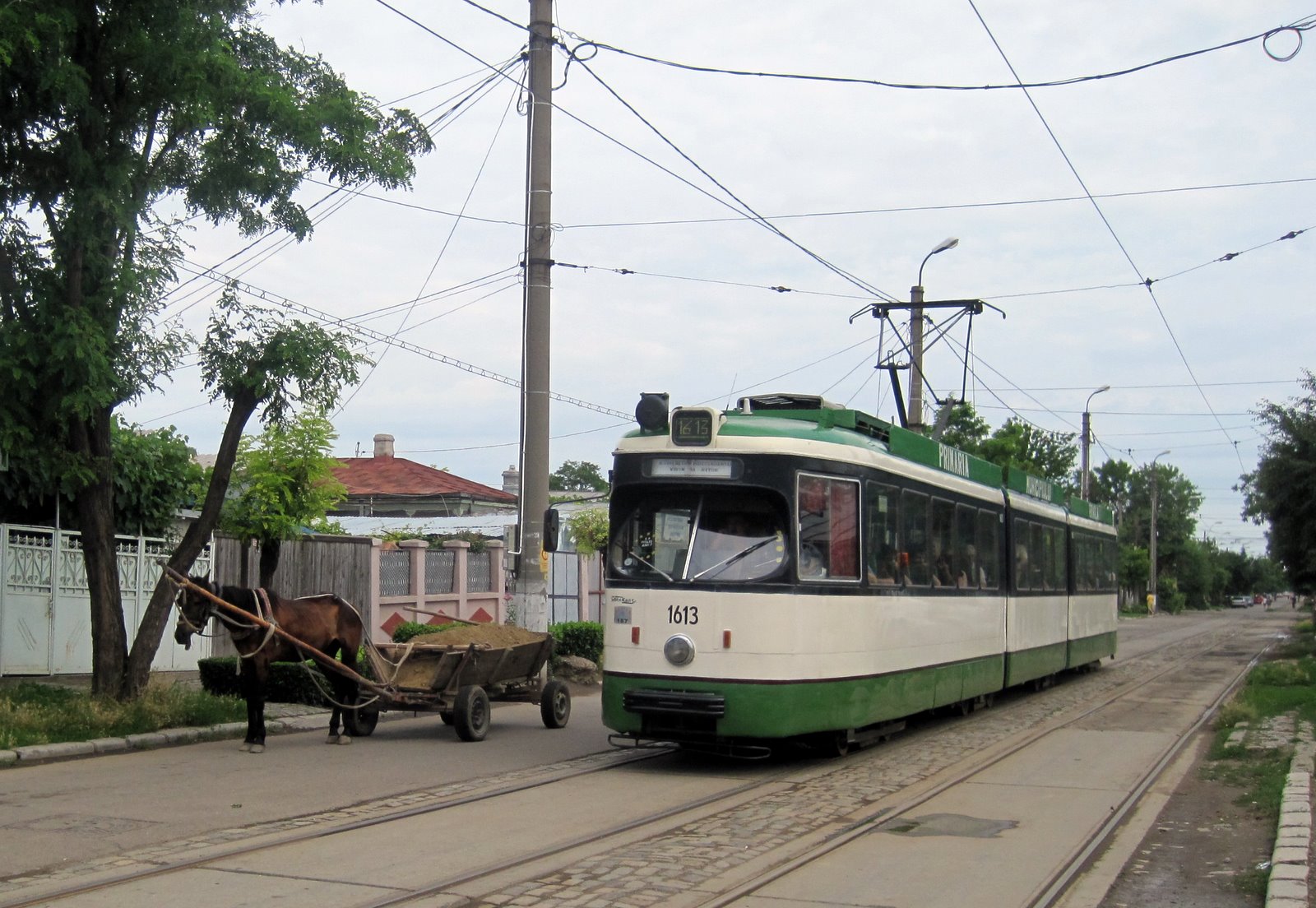
    At present there are only two tram routes in use: 21 a cross town service and an hourly suburban service 24. We saw two of these ex Rotterdam Duwags on service 21.

    Most of the trams we saw on service 21 were from Vienna.

    A single ex Berlin KT4D was operating service 24.

    Although I saw a news report that horse drawn vehicles had been banned from urban areas, they are still around.

    I had to insert two bank notes and four coins into this machine to buy two tickets, it worked fine.
    Posted by Picasa

    Tuesday, July 05, 2011

    Good news from Braila

    in the long term but not for us in the short term.


    Monday, July 04, 2011

    Odds and ends in Galati

    The depot entrance with trams from Berlin, Dresden and Frankfurt.

    McDonalds.

    This was the only ex Dresden Tatra T4D that we saw on the road. It was not in service but Galati trams seem to spend a lot of time driving to and from the depot out of service.

    A Romanian built Timis tram.

    A neat pedestrian crossing over the road but you cross the tram tracks at your own risk.
    Posted by Picasa

    Worn track in Galati

    The Galati tramway seems to have lost the will to live. There are only 3 remaining tram routes: 7, 39 and 44, together with a few peak hour extras to the steel works. A lot of the track is badly worn although the trams themselves are in reasonable condition. Yes it is me on the right.

    The Rotterdam cars are in remarkably good condition for a run down tramway.

    Add caption


    Posted by Picasa